Runner Strength Training 101: What to Prioritize If You're Injury-Prone
Tired of hitting the restart button on your training due to nagging aches? Stop treating the symptoms of running stress and fix the root cause. This step-by-step strength guide shows you exactly what to prioritize to build an injury-proof body in just two days a week.
HEALTH AND FITNESS
Dian Santos Holman
6/25/20266 min read


You lace up your shoes, step outside, and hit your stride. Everything feels amazing for the first mile. The air is crisp, your rhythm is perfect, and your mind is clear.
Then, right on cue, it happens.
That familiar, annoying ache creeps into your left knee. Or maybe it is a tight pull in your Achilles tendon, or a deep throb in your hip. Your stride hitches, your mood plummets, and you realize you are headed straight back to square one.
You love running, but it feels like your body is a ticking time bomb. You have tried resting for weeks, spent a fortune on maximum-cushion shoes, and rolled out your muscles until you are bruised. Yet, the moment you ramp your mileage back up, the same injury returns to haunt you.
Here is the hard truth that standard running culture fails to mention: stretching will not fix a strength deficit.
Running is not just a cardiovascular sport. It is a high-impact, single-leg balancing act. Every single time your foot hits the pavement, your body absorbs a force equal to two to three times your total body weight. If your muscles are not strong enough to absorb that massive kinetic shock, the force does not disappear. It travels straight into your defenseless joints, ligaments, and tendons.
Strength training is not a distraction from your running goals; it is the physical armor that protects them. If you are prone to injuries, you do not need to lift weights like a bodybuilder or spend hours in a commercial gym. You simply need to target the classic runner weak links. Let’s break down the ultimate blueprint to building an injury-proof body.
The Big Three: Common Runner Weak Links
Most running injuries do not happen because your lungs give out or because you lacked willpower. They happen because a specific muscle group quietly stopped doing its job, forcing another body part to overcompensate. When building your bulletproof routine, you must prioritize these three critical areas:
1. The Hips and Glutes (The Stabilization Center)
Your glutes, specifically the gluteus medius on the side of your hip, are responsible for keeping your pelvis level when you run. When these muscles are weak, your pelvis drops on the opposite side every time you take a step. This causes your knee to cave inward, twisting your leg and placing immense stress on your kneecap and IT band. Strong hips act as an internal alignment system, keeping your stride tracking straight.
2. The Calves and Achilles (The Propulsion Springs)
Your lower legs are your body's primary springs. Your calf muscles (the gastrocnemius and soleus) absorb the initial impact of the ground and store that energy to push you forward. If your calves lack endurance, they fatigue early in your run. The shock then transfers directly into your shins and plant fascia, resulting in agonizing shin splints, stress fractures, or Achilles tendinitis.
3. The Core (The Foundation of Control)
A runner's core is much more than just a visible six-pack. It is a 360-degree cylinder of muscle connecting your chest to your pelvis. Think of it as the mast of a ship. If the mast is unstable, the ship sways wildly with every wave, wasting massive amounts of energy. A weak core causes your pelvis to tilt forward, arching your lower back, straining your hamstrings, and ruining your running economy.
The Starter Exercise List: Your 5-Move Armor
You do not need access to complicated gym machines to protect your body. Instead, focus on mastering these five fundamental, multi-joint movement patterns. They are specifically chosen to fix imbalances and build targeted resilience exactly where runners need it most.
[ Goblet Squat ] --> Builds foundational quad & glute power
[ Romanian Dead ] --> Strengthens the hamstring & hip hinge
[ Split Squat ] --> Eliminates left-to-right leg imbalances
[ Calf Raise ] --> Toughens the Achilles tendon spring
[ The Deadbug ] --> Stabilizes the core during limb movement
1. The Squat Pattern: The Goblet Squat
Why it works: It builds foundational quad and glute strength, teaching your knees to track safely over your toes under a heavy load.
How to do it: Hold a single dumbbell or kettlebell vertically against your chest like a goblet. Place your feet shoulder-width apart. Keeping your chest proud and your back straight, sit back and down as if lowering into a chair. Drive through your heels to stand back up.
2. The Hinge Pattern: The Romanian Deadlift (RDL)
Why it works: Runners are notoriously "quad-dominant," leaving their back-body weak. This move targets the hamstrings and glutes, which act as the brakes for your stride.
How to do it: Stand tall holding two weights in front of your thighs. Keep a very soft, slight bend in your knees. Softly push your hips straight backward as if trying to touch a wall behind you with your glutes. Lower the weights down the front of your shins until you feel a stretch in your hamstrings, then squeeze your glutes to stand.
3. The Single-Leg King: The Split Squat
Why it works: Running is a one-legged sport. Standard squats allow your dominant, stronger leg to take over. Single-leg movements isolate each side, violently exposing and fixing muscle imbalances between your left and right legs.
How to do it: Take a large step forward so you are in a staggered stance. Keeping your torso upright, lower your back knee straight down toward the floor until it sits just an inch above the ground. Your front thigh should be parallel to the floor. Drive through your front heel to return to the top. Complete all reps on one side before switching.
4. The Spring Builder: The Weighted Calf Raise
Why it works: It builds thickness and capacity in the calf muscles and drastically increases the tensile strength of the Achilles tendon.
How to do it: Stand on the edge of a step or weight plate with your heels hanging off the back. Hold a dumbbell in one hand for resistance. Slowly lower your heels below the level of the step to get a deep stretch, then explode upward onto your tiptoes. Hold the very top position for one solid second before lowering down with control.
5. The Functional Core: The Deadbug
Why it works: This exercise teaches your core to stay completely locked and stable while your arms and legs are moving independently—which is the exact definition of running.
How to do it: Lie flat on your back with your arms pointing straight at the ceiling and your knees bent at a 90-degree angle. Press your lower back firmly into the floor so there is zero gap. Slowly extend your right arm backward and your left leg forward until they are both hovering just above the floor. Return to center, and repeat with the opposite arm and leg.
Volume Guidance: Complement Your Runs, Don't Ruin Them
The single biggest mistake runners make when they start lifting is doing too much, too soon. If you finish a gym session so incredibly sore that you cannot complete your scheduled runs, your program has failed you. Your strength training must support your running, not destroy it.
To keep your body fresh and adapting, follow this conservative, highly effective starter volume framework:
Frequency: Dedicate just 2 days a week to this routine. Keep these sessions separate from your hardest running days, or perform them a few hours after a hard run so your rest days remain true rest days.
Sets and Reps: Perform 2 to 3 sets of 8 to 12 repetitions for each exercise. Rest for roughly 60 to 90 seconds between sets to allow your nervous system to recover.
Weight Selection: Do not guess on weight. Choose a load where the last 2 repetitions of every single set feel genuinely difficult, but you can still maintain absolutely perfect form without shaking or collapsing.
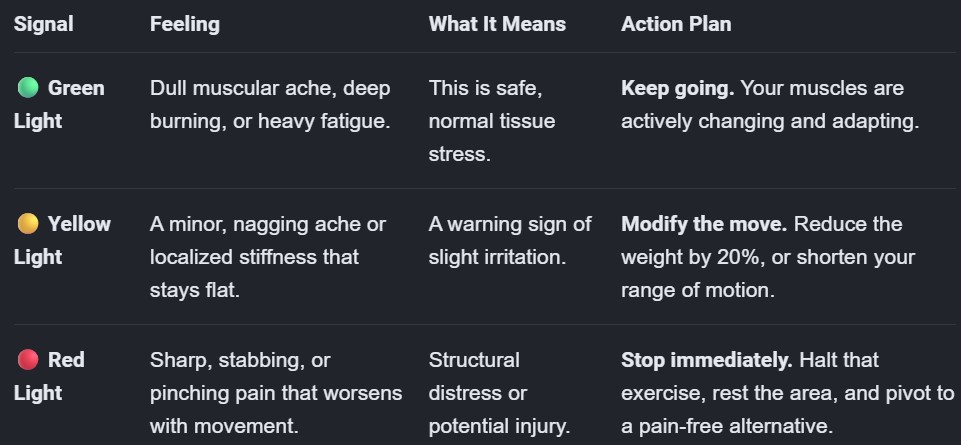
Red Light, Green Light: How to Adjust for Pain
When you start lifting weights, your muscles will experience standard delayed onset muscle soreness (DOMS). However, structural joint pain is entirely different. Use this simple, intuitive traffic light system during your workouts to audit your movement and stay safe:
Stop Rebuilding, Start Progressing
Chronic injuries do not have to be an inevitable tax you pay for loving the sport of running. You do not have to live in a perpetual cycle of injury, rest, recovery, and re-injury.
By dedicating just 20 to 30 minutes, twice a week, to intentional, targeted strength work, you stop blindly treating the superficial symptoms of running stress and finally fix the root cause. Build your structural armor, protect your fragile joints, and unlock a future of completely pain-free miles.