Stop Stretching Blindly: Why Your Warm-Up Might Be Wrecking Your Workout
Are you holding static stretches before you run or lift? Discover how matching the right stretch.. static, dynamic, or PNF, to the right time can unlock instant flexibility and peak athletic performance.
HEALTH AND FITNESS
Dian Santos Holman
6/17/20264 min read


We have all been there. You walk into the gym, drop your bag, reach for your toes, and hold that position for 30 cold seconds. It is what we were taught in gym class, right?
But what if that exact ritual is actually draining your power and slowing you down?
Not all stretches are born equal. Sinking into a deep, unmoving stretch before an explosive workout can temporarily numb your nervous system and blunt muscle strength. To move better, feel better, and avoid injury, you need to match your stretch to your specific goal.
Let us break down the three main types of stretching so you know exactly when and how to use them.
1. Dynamic Stretching: The Pre-Workout Power-Up
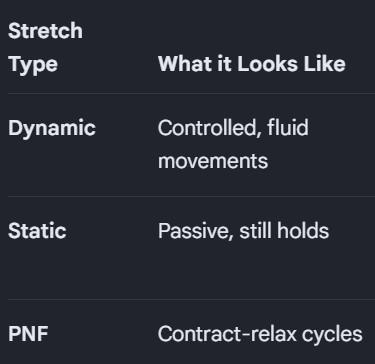
Dynamic stretching is all about continuous, controlled movement. Instead of holding a position, you repeatedly move your joints and muscles through their full range of motion. Think of movements like leg swings, walking lunges, and arm circles.
How it works: It acts like a biological thermostat, pumping fresh blood flow to your muscles, lubricating your joints, and firing up your central nervous system.
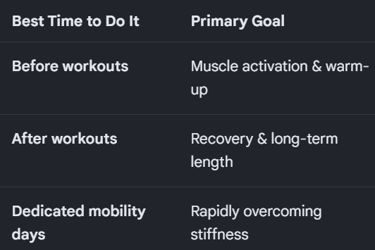
When to use it: Always use it before exercise. A landmark literature review by sports scientists David Behm and Anis Chaouachi confirmed that dynamic stretching maintains or directly improves power, speed, and agility.
Best for: Pre-run routines, weightlifting warm-ups, and field sports.
2. Static Stretching: The Post-Workout Cool-Down
Static stretching is the classic "stretch and hold" method. You lengthen a muscle to its comfortable limit and hold it still, usually for 15 to 60 seconds.
How it works: According to the Mayo Clinic, safe static stretching requires smooth movements without bouncing, which relaxes the nervous system and tells your muscle fibers it is safe to unwind.
When to use it: Save this strictly for after your workout or on rest days. Because it temporarily reduces muscle responsiveness, doing it right before heavy lifting or sprinting can actually impair performance. However, a systematic health review published in the Journal of Physical Education and Sport (JKES) highlights that static stretching is incredibly safe and effective for long-term flexibility, reducing muscle tension, and improving quality of life.
Best for: Post-workout recovery, yoga sessions, and correcting chronic postural tightness.
3. PNF Stretching: The Secret Weapon for Extreme Flexibility
Proprioceptive Neuromuscular Facilitation (PNF) sounds incredibly complicated, but it is just a "contract-and-relax" method. It usually requires a partner or a resistance band.
How it works: You stretch a muscle, contract it hard against resistance for about 3 to 6 seconds, relax it completely, and then immediately push it into a deeper passive stretch. This tricks your brain's natural reflexes into bypassing its normal "stop" signals, granting you instant access to a brand-new range of motion.
When to use it: Use it during dedicated mobility blocks or after your main workouts. Clinical guidelines noted in PubMed research on PNF stretching reveal that it changes your mind's perception of stretch tolerance faster than any other method. Just keep your contractions moderate—around 20% to 60% of your maximum effort—to keep your tissues safe.
Best for: Rapidly breaking through stubborn flexibility plateaus.
The Bottom Line
Stop treating stretching like a mindless chore. If you are heading out for a run or stepping under a barbell, wake your body up with dynamic movements. When you are done and covered in sweat, reward your muscles with a slow, static melt or a targeted PNF release. Listen to your body, match the method to the moment, and watch your movement transform.
Quick Cheat Sheet: What Does Your Body Need Right Now?
Dynamic vs. Static Stretching: Is One Better? - Cleveland Clinic
Aug 29, 2024 — Pros. Increases flexibility. Reduces muscle tension. Improves posture. May promote relaxation and stress relief. Cons. May decreas...
Cleveland Clinic Health Essentials
Static vs. Dynamic Stretching: Which is Better for Runners?
Static vs. Dynamic Stretching: Which is Better for Runners? * Static Stretching. Static stretching involves holding a stretch in a...
Princeton Sports and Family Medicine
The benefits of static stretching on health: a systematic review
Jan 12, 2024 — Material and methods: This review followed PRISMA guidelines. PubMed, Web of Science, Scopus, MEDLINEOnline medical articles, and ...
Journal of Kinesiology and Exercise Sciences
Stretching Benefits
Stretching is simple, but it has powerful effects on both your body and performance. Here’s what it actually does:
🧘♂️ Improves Flexibility
Stretching helps your muscles and joints move through a full range of motion. This makes everyday movements and workouts feel easier and more efficient.
💪 Reduces Injury Risk
Flexible muscles are less likely to get strained or pulled. Regular stretching helps your body handle movement and stress better.
🔄 Enhances Blood Flow
Stretching increases circulation, bringing more oxygen and nutrients to your muscles. This can improve performance and recovery.
🏃 Boosts Workout Performance
Better mobility = better form.
When your body moves properly, you lift stronger, run smoother, and perform more efficiently.
😌 Reduces Muscle Tightness & Soreness
Stretching helps release tension and can reduce stiffness after workouts or long periods of sitting.
🧠 Supports Relaxation & Stress Relief
Slow, controlled stretching can calm your nervous system and reduce stress—especially when combined with deep breathing.
⚖️ Improves Posture
Tight muscles (especially from sitting) pull your body out of alignment. Stretching helps correct imbalances and improve posture over time.

