The Six-Pack Lie: Why My Shredded Abs Couldn't Stop My Back From Hurting (and What Actually Worked)
Think a strong core means doing hundreds of crunches? Think again. I learned the hard way that chasing the ab burn was actually causing my chronic lower back tightness. Here is the exact "anti-movement" formula that fixed my posture, saved my back, and unlocked true functional strength.
HEALTH AND FITNESS
Dian Santos Holman
6/22/20265 min read


I used to think a strong core meant one thing: a chiseled six-pack. I spent years chasing that look, cranking out hundreds of crunches, hanging leg raises, and sit-ups until my hip flexors burned. Visually, it worked. But functionally? I was a mess. At 26, I couldn't pick up a grocery bag or bend over to tie my shoes without a sharp, warning shoot of pain through my lower back.
I felt like an absolute fraud. How could someone who spent two hours a day in the gym feel so physically fragile?
That was the day I learned the hard way that a "core workout" is not the same thing as "core stability." One is about moving your spine to show off muscles; the other is about keeping your spine perfectly still so you don't break yourself. Once I stopped chasing the burn and started building stability, my back pain vanished, my lifting weights skyrocketed, and I finally felt as strong as I looked.
Whether you are a lifter trying to squat heavier, a runner battling lower back tightness, or someone desperately recovering from a nagging back injury, here is the truth about what your midsection actually needs to move well, stay pain-free, and feel truly powerful.
The Big Mix-Up: Movement vs. Resistance
Most people use the words "core workout" and "core stability" interchangeably, but they are complete opposites in how they treat your spine.
The Core Workout (Global Muscles): Think crunches, Russian twists, and sit-ups. These target the outer layer of muscles like the rectus abdominis. Their job is to force your spine to bend and twist.
Core Stability (Local Deep Muscles): Think planks, bird-dogs, and suitcase carries. These target the deep, hidden muscles like the transverse abdominis and multifidus. Their job is to prevent your spine from bending and twisting when outside forces try to move it.
When you only train for movement, you build a rigid outer shell over an unstable foundation. The moment you pull a heavy deadlift, log your third consecutive mile on asphalt, or twist awkwardly to grab something from the back seat, that deep layer fails. Your lower back takes the entire hit.
The Solution: The "Anti-Movement" Framework
True core stability is built on three pillars of resistance. If you want a body that feels bulletproof, your routine needs to include these three concepts:
1. Anti-Extension (Stop the Arch)
The Goal: Preventing your lower back from overarching when your arms or legs move. This is crucial for lifters keeping a neutral spine overhead, and runners preventing a pelvic tilt.
The Fix: Swap standard sit-ups for a Deadbug.
2. Anti-Rotation (Stop the Twist)
The Goal: Keeping your hips and shoulders perfectly square when an outside force tries to twist you sideways. This prevents runners from wasting energy side-to-side and protects injured discs from shearing forces.
The Fix: The Pallof Press. Hold a resistance band or cable at chest height while standing sideways to the anchor point. Press your hands straight out in front of you. The band will try to twist your torso; your job is to stay absolutely frozen.
3. Anti-Lateral Flexion (Stop the Side-Bend)
The Goal: Staying perfectly upright when a heavy weight is pulling you down to one side.
The Fix: The Suitcase Carry. Pick up one heavy dumbbell or kettlebell in just one hand. Walk slowly and deliberately for 50 feet without letting the weight tilt your torso or make you limp.
Mastering the Foundation: Step-by-Step Form Cues
To build absolute core stability without triggering existing back issues, you must execute these two essential movements with zero momentum and flawless control.
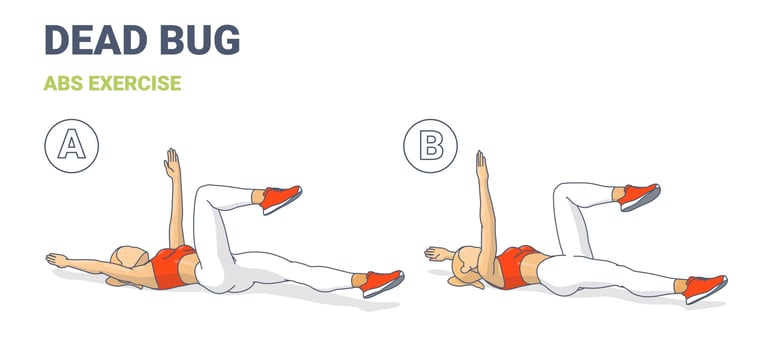
The Deadbug
This movement teaches your brain to keep your lower back anchored firmly to the ground while your limbs are in motion. It mimics the lower body mechanics of running without the joint impact.
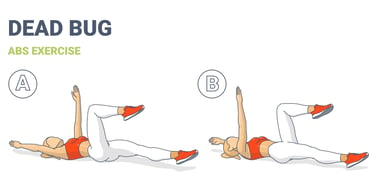
The Setup: Lie flat on your back. Raise your arms straight up toward the ceiling. Bend your knees and hips to a 90-degree angle, keeping your feet up.
The Cue: Imagine there is a folded $100 bill hidden right under your lower back. Press your spine down into the floor as hard as you can so nobody can pull that money out.
The Movement: Take a deep breath in. As you exhale slowly, lower your right arm behind your head and extend your left leg straight out just above the floor.
The Checkpoint: Only lower your limbs as far as you can without letting your lower back lift or arch off the floor. Return to the start position and alternate sides.
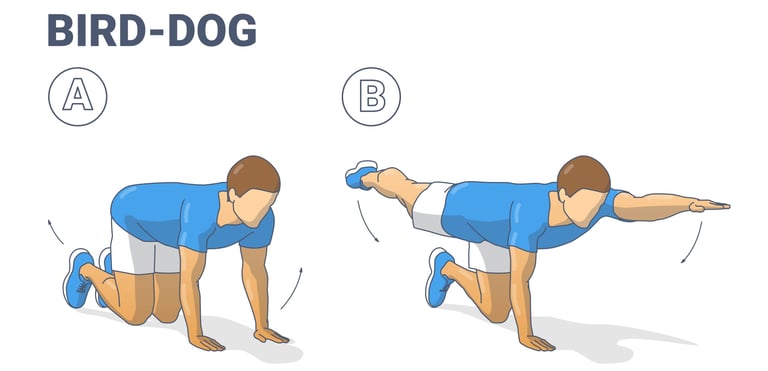
The Bird-Dog
The Bird-Dog builds cross-body stability between your shoulders and hips. It strengthens the spinal support muscles that keep lifters stable under a heavy barbell and keeps a runner's torso upright over long distances.
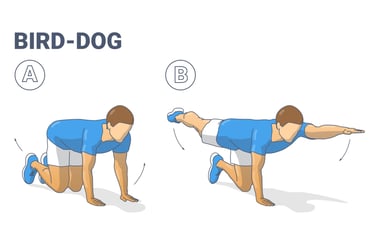
The Setup: Start on your hands and knees in a tabletop position. Place your hands directly under your shoulders and your knees directly under your hips.
The Cue: Balance an imaginary, hot cup of coffee right on your lower back. If your hips tilt or twist even a tiny fraction, you will spill it.
The Movement: Slowly reach your right arm straight forward while simultaneously kicking your left leg straight back. Hold this fully extended position for two seconds.
The Checkpoint: Do not lift your leg up high into the air, as this arches your back. Instead, focus on driving your heel back to wall behind you and your fingertips to the wall ahead. Squeeze your glute at the top, then slowly return to the center.
Your 10-Minute Daily Stability Reset
You do not need an entire hour dedicated to abs to build a stable foundation. Doing these movements right before your main workout, before a run, or first thing in the morning resets your nervous system and wakes up those deep stabilization muscles.
Try this simple, low-impact circuit tomorrow:
Bird-Dog: 3 sets of 8 slow, controlled reps per side.
Deadbug: 3 sets of 8 slow, controlled reps per side.
Side Plank: 3 sets of 20 seconds per side. Drive your hips high up to the ceiling, keeping a perfectly straight line from your head to your heels.
Stop punishing your spine with endless crunches just to make it look a certain way. Real strength starts deep inside, where no one else can see it, but where you will feel it every single time you move. Shift your focus from making your core move to keeping it steady, and watch how fast your body rewards you.
A strong core fixes more than you think


Core Stability vs Core Workouts: What’s the Difference?
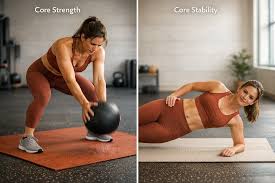
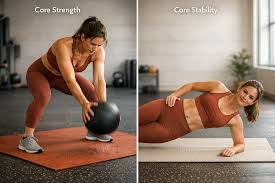
"To fix my back and build true, functional strength, I had to completely change my approach. I stopped asking my core to create movement and started asking it to resist movement."


Core work = better movement


